Controls all animated illustrations on this page. Your choice is remembered across the website when browser storage is available.

The reading room

One shelf.
Many ways of seeing.

I read across science, philosophy, fiction, biographies, technology, and human behavior. Some books teach science. Some teach courage. Some simply reignite old addictions — especially science fiction.

A quiet moment in the reading room An open book rests beside a stack of books and a brass reading lamp. A paper leaf gently rises, turns across the spine, and settles onto the other side.
Science, stories, and the spaces between.
15works on
my bookshelf

Books that shaped how I think.

Original title artwork for Project Hail Mary.

The spark that brought me back

Project Hail Mary

Andy Weir · Science fiction

This book reignited my science-fiction addiction. It reminded me how much I enjoy stories where science, survival, humor, and imagination meet.

The collection, one idea at a time

Pick a book.
Follow a question.

A little about each book, and a question to carry beyond its pages.

Original title artwork for The Selfish Gene.

Life & evolution

The Selfish Gene

Richard Dawkins

Dawkins explains natural selection from the perspective of genes that persist across generations. The book examines competition, cooperation, and apparently selfless behavior through that lens, asking how such patterns can evolve. Its central question is what helps a gene spread, with behavior considered through evolutionary explanations rather than judgments about how people ought to live.

  • Natural selection
  • Cooperation
  • Genes
A question to carry with you

How does changing the level of explanation change the way we understand cooperation?
About this book ↗
Original title artwork for The Extended Phenotype.

Life & evolution

The Extended Phenotype

Richard Dawkins

Dawkins follows the effects of genes beyond the bodies that carry them. A beaver’s dam and changes in another animal’s behavior become part of the discussion, extending the idea of a phenotype into the surrounding world. The book develops the argument of The Selfish Gene and asks where an organism’s evolutionary influence really ends.

  • Adaptation
  • Environment
  • Evolutionary thinking
A question to carry with you

Where should we draw the boundary between an organism and the effects it has on its environment?

About this book ↗
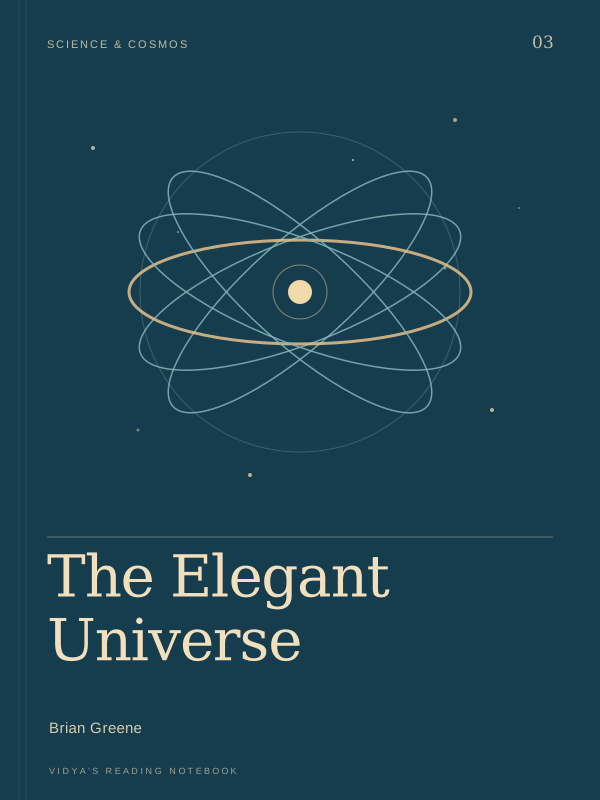
Original title artwork for The Elegant Universe.

Science & cosmos

The Elegant Universe

Brian Greene

Greene introduces string theory and the search for a common description of nature’s forces. Using everyday analogies, he explores tiny vibrating strings, extra dimensions, and the possibility that spacetime behaves in unexpected ways. These are theoretical attempts to connect gravity and quantum physics, inviting curiosity about both mathematical elegance and experimental evidence.

  • String theory
  • Extra dimensions
  • Unification
A question to carry with you

What makes a beautiful theory convincing, and what evidence would help test it?

About this book ↗
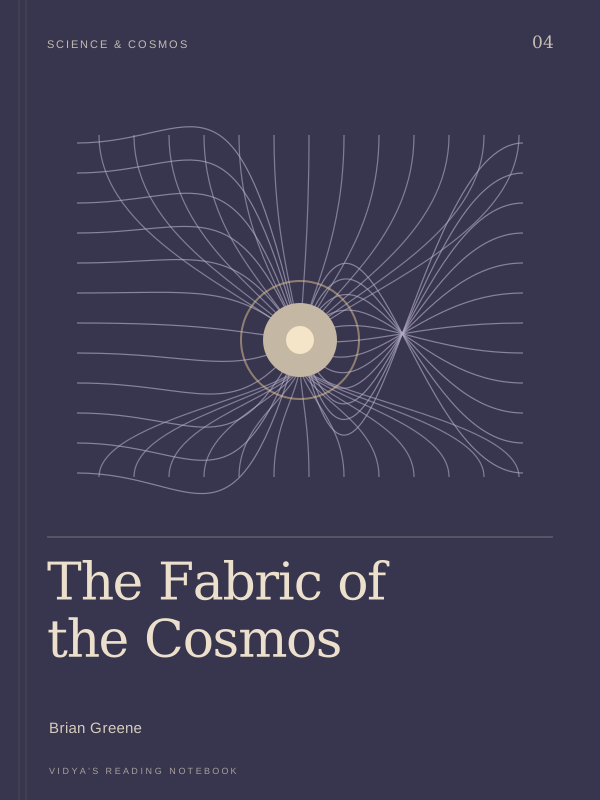
Original title artwork for The Fabric of the Cosmos.

Science & cosmos

The Fabric of the Cosmos

Brian Greene

Space and time feel familiar until Greene starts asking what they actually are. This book explores the direction of time, quantum uncertainty, and the structure and history of the universe through accessible analogies. It connects everyday intuition with concepts from modern physics, showing why the apparent simplicity of our surroundings can hide difficult questions.

  • Spacetime
  • Quantum uncertainty
  • Cosmology
A question to carry with you

Which assumptions about space and time come from everyday experience rather than physical evidence?

About this book ↗
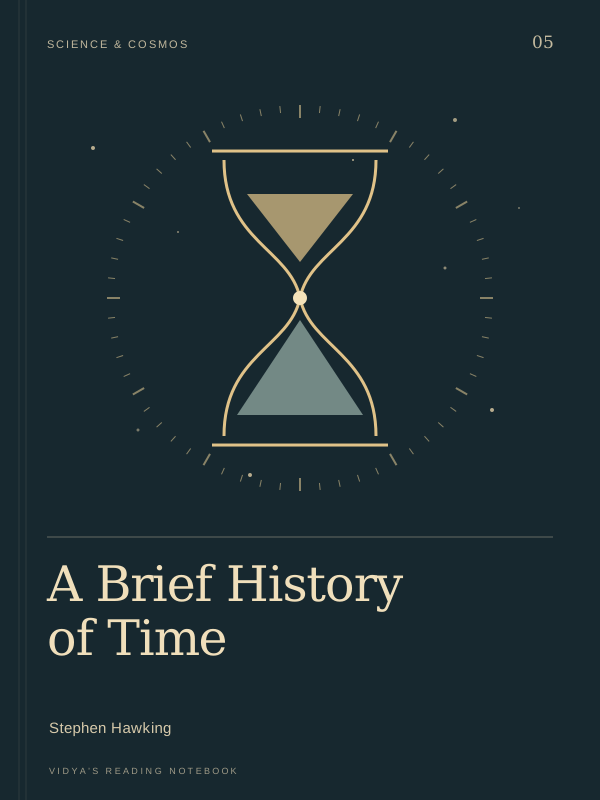
Original title artwork for A Brief History of Time.

Science & cosmos

A Brief History of Time

Stephen Hawking

Hawking guides the reader through questions about the universe’s beginning, its possible boundaries, and the direction of time. Black holes, particles, and the search for deeper physical explanations provide the route. The appeal lies in bringing enormous questions within reach while leaving room for the uncertainty that makes cosmology an ongoing scientific inquiry.

  • Black holes
  • Time
  • Origins
A question to carry with you

How do questions about the beginning of the universe change our understanding of time?

About this book ↗
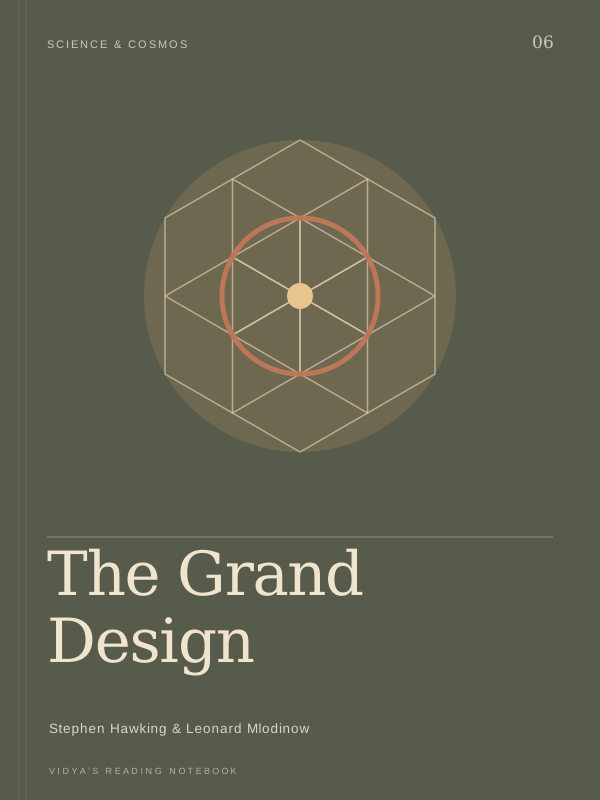
Original title artwork for The Grand Design.

Science & cosmos

The Grand Design

Stephen Hawking & Leonard Mlodinow

Hawking and Mlodinow ask how physical laws might explain the universe’s existence and apparent order. Their account moves through quantum ideas, possible cosmic histories, and proposals associated with M-theory and multiple universes. It is an exploration of ambitious theoretical explanations, with philosophical questions about reality and origins running alongside the physics.

  • Quantum ideas
  • Physical laws
  • Reality
A question to carry with you

What would count as a satisfying explanation for why the universe exists?

About this book ↗
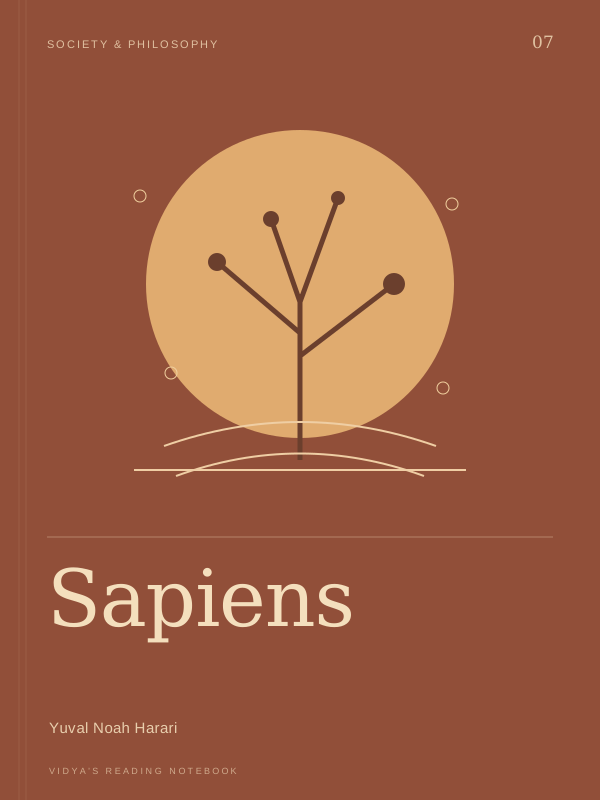
Original title artwork for Sapiens.

Society & philosophy

Sapiens

Yuval Noah Harari

Harari offers a sweeping interpretation of human history, connecting evolutionary origins with agriculture, money, religion, and modern societies. He gives particular attention to the shared stories that allow large groups to cooperate. The book invites readers to examine familiar institutions from a wider perspective and to question how growing collective power relates to individual well-being.

  • Human history
  • Shared beliefs
  • Society
A question to carry with you

Which shared stories make cooperation possible, and when should those stories be questioned?

About this book ↗
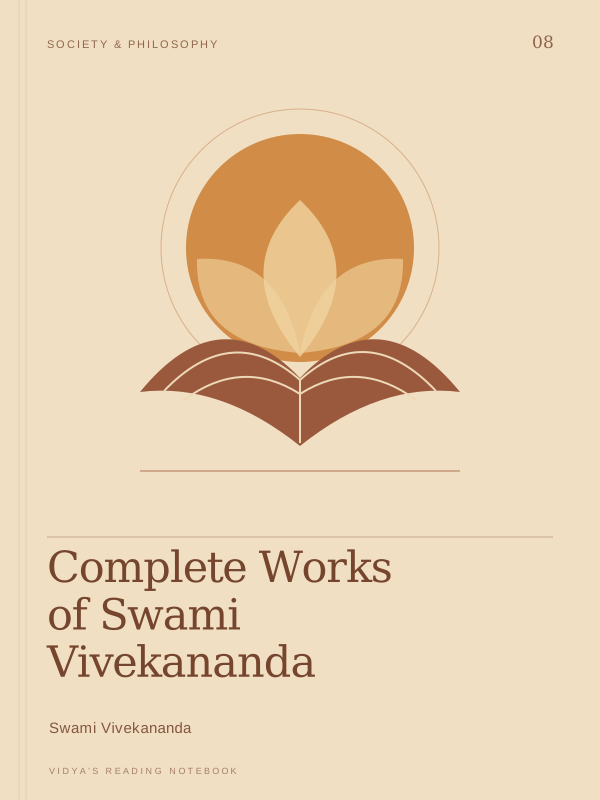
Original title artwork for Complete Works of Swami Vivekananda.

Society & philosophy

Complete Works of Swami Vivekananda

Swami Vivekananda

This collection brings together Vivekananda’s lectures, writings, conversations, and letters. Its subjects range from Vedanta and different paths of yoga to work, character, education, and religious understanding. Across the volumes, spiritual ideas are repeatedly connected with practical life, creating a collection that can be explored by theme as well as read in sequence.

  • Vedanta
  • Character
  • Practical philosophy
A question to carry with you

How can philosophical or spiritual convictions become useful in ordinary work and relationships?

About this book ↗
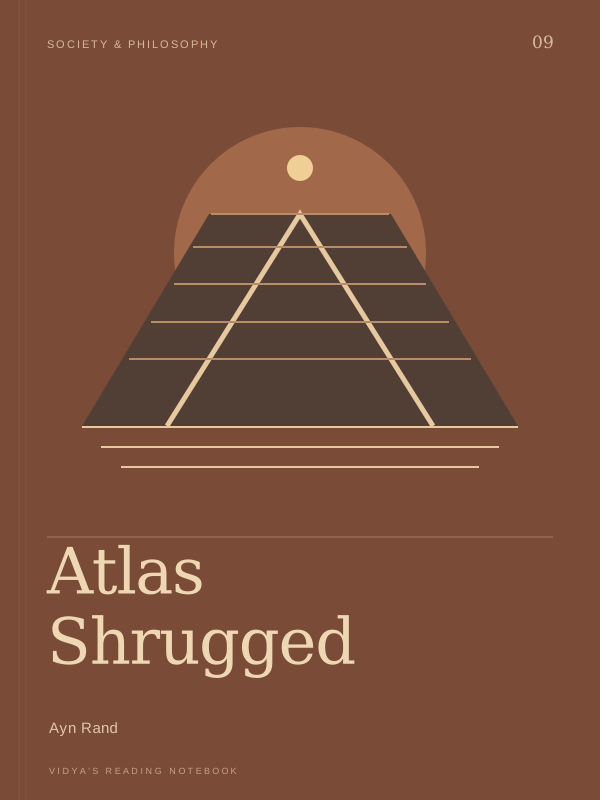
Original title artwork for Atlas Shrugged.

Society & philosophy

Atlas Shrugged

Ayn Rand

Rand builds a philosophical novel around industrial ambition, productive work, and the conflicts between individuals and society. A railroad executive and other creators face a mystery with consequences that reach far beyond their businesses. Through the story, Rand develops her philosophy of Objectivism, offering strong positions on independence, responsibility, and the value of human achievement.

  • Individualism
  • Productive work
  • Objectivism
A question to carry with you

How should a society balance individual independence with obligations to other people?

About this book ↗
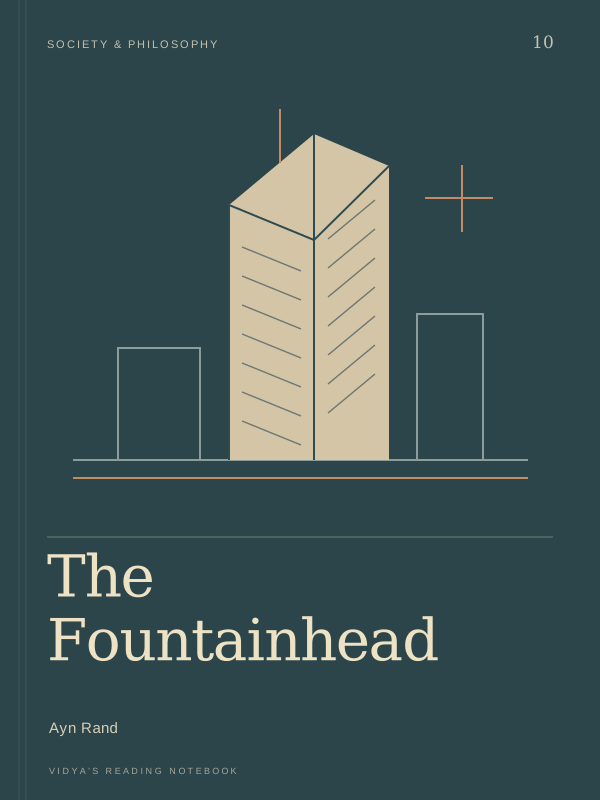
Original title artwork for The Fountainhead.

Society & philosophy

The Fountainhead

Ayn Rand

Architect Howard Roark’s refusal to compromise his creative vision drives Rand’s story of ambition, influence, and public approval. Architecture becomes the setting for her argument about individual judgment and the pressures of conformity. The novel offers a forceful perspective on integrity, leaving readers with plenty to examine about conviction, compromise, and the responsibilities of creative work.

  • Creative integrity
  • Architecture
  • Conformity
A question to carry with you

When does holding to a creative vision show integrity, and when does it become inflexibility?

About this book ↗
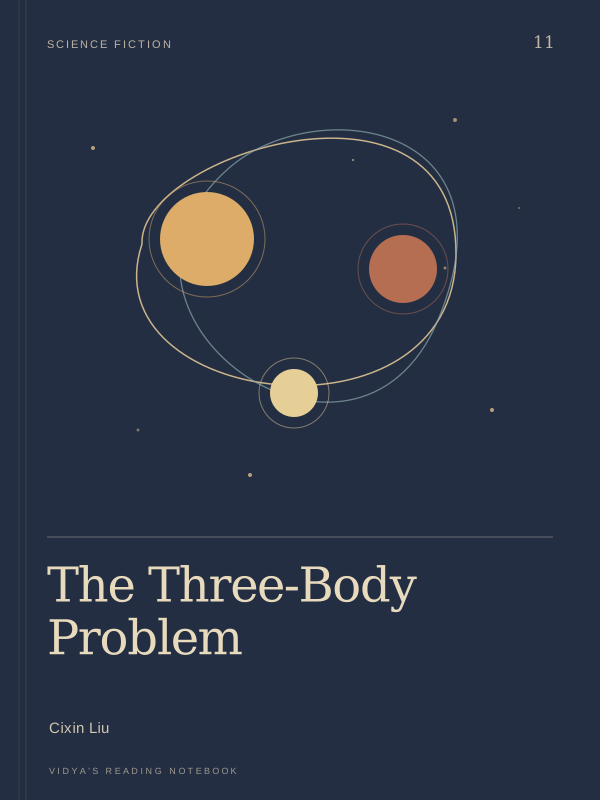
Original title artwork for The Three-Body Problem.

Science fiction

The Three-Body Problem

Cixin Liu

Liu begins amid China’s Cultural Revolution and opens a story in which a scientific search for contact reaches far beyond Earth. The novel places enormous questions about civilization, trust, and humanity’s future alongside political history and scientific mystery. It is the opening volume of a larger story, with its scale growing as the clues accumulate.

  • First contact
  • Civilization
  • Scientific mystery
A question to carry with you

How might contact with another civilization change the way humanity sees itself?

About this book ↗
Original title artwork for Project Hail Mary.

Science fiction

Project Hail Mary

Andy Weir

Ryland Grace wakes far from Earth with missing memories and a mission whose stakes gradually become clear. Survival depends on recovering what he knows and working through a succession of scientific puzzles. Weir turns observation, experimentation, and practical problem-solving into an adventure, with humor and human vulnerability accompanying the urgent questions of how to keep going.

  • Problem-solving
  • Space exploration
  • Survival
From my notebook

This book reignited my science-fiction addiction. It reminded me how much I enjoy stories where science, survival, humor, and imagination meet.

A question to carry with you

What makes a difficult problem feel solvable when the stakes are overwhelming?

About this book ↗
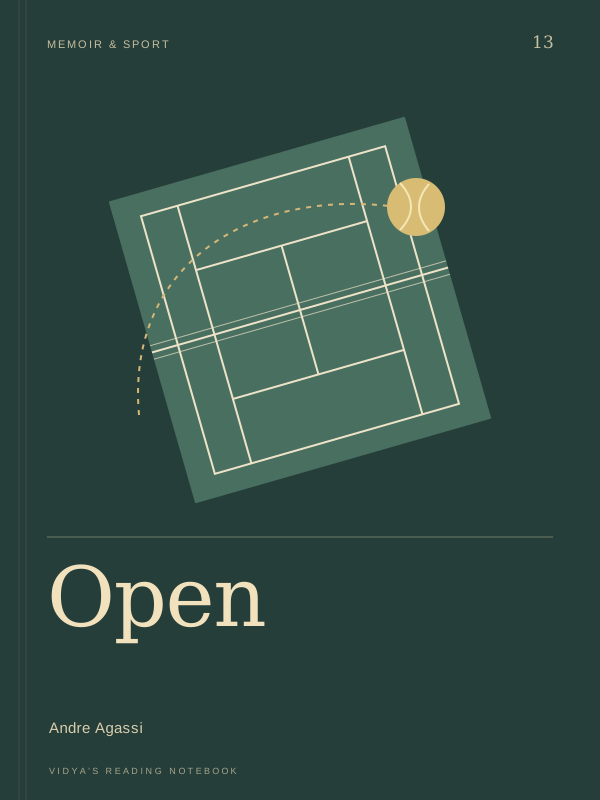
Original title artwork for Open.

Memoir & sport

Open

Andre Agassi

Agassi’s autobiography follows the pressures behind a life spent in professional tennis. Early training, public success, difficult relationships, and an uneasy connection with the sport all sit beside the matches. It offers a personal account of achievement and dissatisfaction, with the search for purpose extending beyond rankings, trophies, and the expectations placed on a champion.

  • Tennis
  • Identity
  • Purpose
A question to carry with you

How do we define success when achievement and personal fulfillment do not arrive together?

About this book ↗
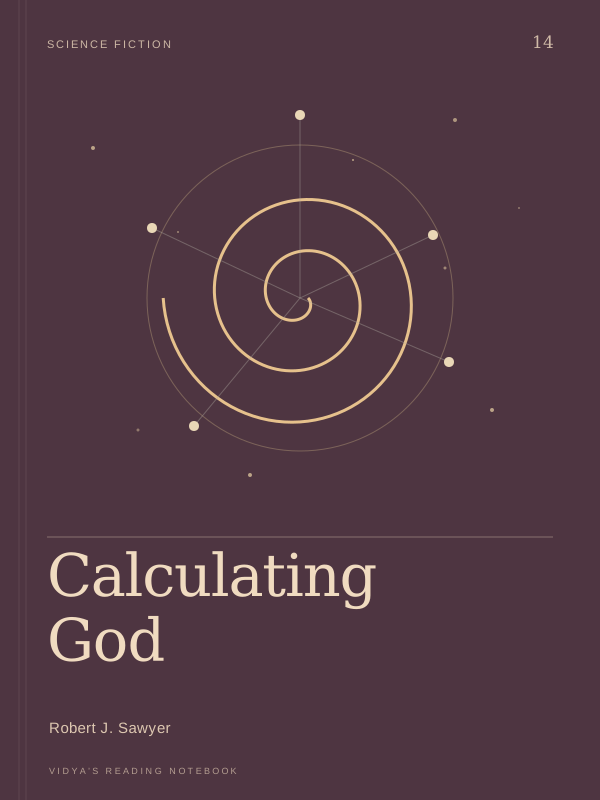
Original title artwork for Calculating God.

Science fiction

Calculating God

Robert J. Sawyer

An alien visitor arrives at a Toronto museum looking for a paleontologist, setting off a discussion about life’s history and the possibility of a creator. Sawyer uses an imagined encounter to bring science, evidence, and belief into conversation. The novel’s questions grow in scale while remaining rooted in the challenge of interpreting unfamiliar information.

  • Evidence & belief
  • Evolution
  • First contact
A question to carry with you

What kind of evidence could persuade us to reconsider a deeply held belief?

About this book ↗
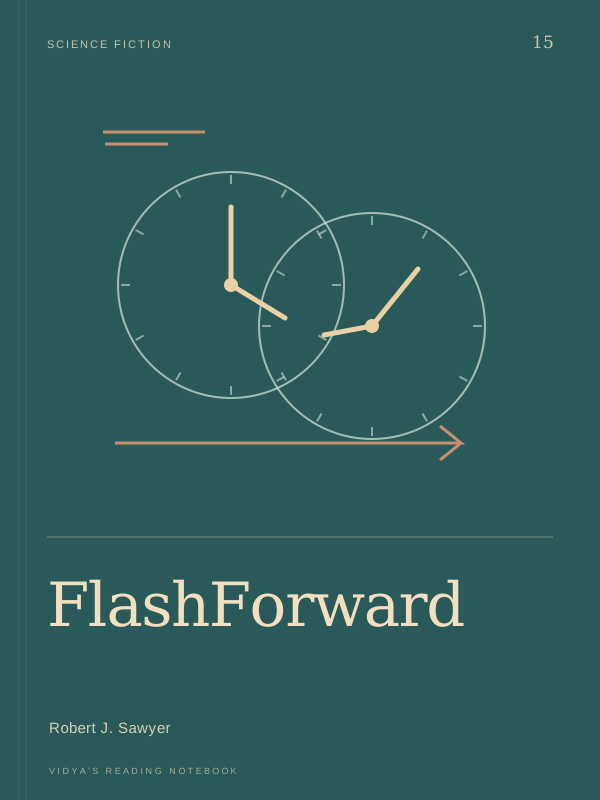
Original title artwork for FlashForward.

Science fiction

FlashForward

Robert J. Sawyer

A physics experiment gives humanity a brief glimpse of its own future, turning an extraordinary scientific event into a deeply personal dilemma. People must decide what to do with knowledge they never expected to have. Sawyer explores how foreknowledge could alter relationships, ambitions, and choices, while asking whether a future once observed can still be changed.

  • Time
  • Free will
  • Foreknowledge
A question to carry with you

Would knowing a fragment of your future make your present choices freer or more constrained?

About this book ↗

Original title illustrations created for this notebook. Book introductions link to publisher, author, or primary-text sources.

The thread through it all

Why I read.

Books help me think about engineering, society, philosophy, human behavior, leadership, science, and the future from many angles.

Books are how I borrow lifetimes of thinking from people I may never meet.
Original title artwork for Project Hail Mary.

From Vidya’s reading shelf

Science fiction

Project Hail Mary

Andy Weir

    About this book ↗

    Use the arrow keys to explore. Escape closes the notes.